
Build contest sales packages that deliver ROI by redefining your discovery process & positioning your pitch around outcomes—not inventory.
Media sales strategies have centered on assembling the right mix of advertising products—digital, print, social, email—into a compelling package.
But here’s the reality: advertisers don’t want products. They want results.
And more specifically, they want results they can measure.
So how do you build sales packages that consistently deliver ROI? It starts with rethinking the role of promotions, redefining your discovery process, and positioning your pitch around outcomes—not inventory.
Go To Market
High-performing campaigns don’t start with a product—they start with a deep understanding of the advertiser.
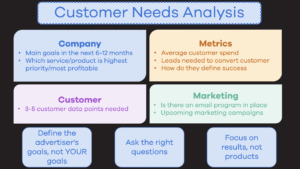
A strong Customer Needs Analysis (CNA) focuses on four key areas:
Company Goals
- What are their top priorities over the next 6–12 months?
- Which products or services are most profitable?
- What seasonal or promotional opportunities are coming up?
Customer Insights
- Who is their ideal buyer?
- What data points matter most in identifying a qualified lead?
Marketing Needs
- Do they have an email program in place?
- What current campaigns are they running?
Success Metrics
- What is the average customer value?
- How many leads does it take to generate a sale?
- How do they define a “successful” campaign?
This last piece is critical. There’s no universal benchmark for success—no perfect number of entries or opt-ins. Success is relative to the advertiser’s business model and their own version of success.
Matching Promotions to Campaign Goals
Once you understand the advertiser’s objectives, you can align the right promotional format to those goals.
Different promotion types drive different outcomes:
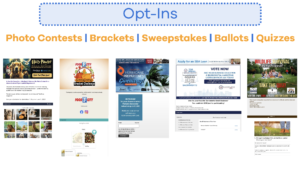
For Opt-Ins & Engagement
- Quizzes
- Brackets
- Ballots
- Sweepstakes
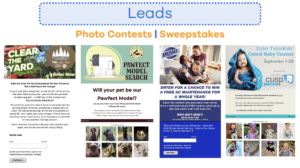
For Lead Generation
- Sweepstakes
- Photo contests
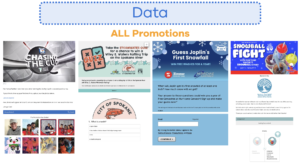
For Data Collection
- All promotion types
The key is to position promotions not as a one-size-fits-all solution, but as a custom strategy tied to specific outcomes.
The Power of the Right Prize
A common misconception is that bigger prizes automatically lead to better results. In reality, the best-performing prizes are aligned—not just expensive.
The formula is simple:
Relevance + Value = Participation
Relevance ensures you attract the right audience. Value drives participation
For example:
A home improvement company promoting a roof or window giveaway will attract highly qualified, in-market participants.
A generic prize may generate volume—but not quality leads.
The prize should try to reflect the advertiser’s core offering to ensure every entry has meaningful intent.
Building a High-Impact Sales Package
Once the strategy is defined, you can build a package that supports it.
A strong promotion-based package should include:
- The promotion itself (central driver)
- Email marketing
- Digital advertising
- Social promotion
- Core media
Your vast options of advertising offerings will also feed into the campaign, increasing reach and potential ROI. Each channel plays a role in driving traffic and participation—but the promotion remains the engine of ROI.
The Pitch Solution
One of the biggest mistakes in sales reps make is is leading with the product.
Bad pitch:
“I have a sweepstakes I think you’d be perfect for.”
This approach:
- Centers on your offering—not their goals
- Lacks context
- Feels transactional
Strong pitch:
“Let’s build a lead-generating campaign that delivers in-market prospects, grows your social audience, and increases brand awareness—supported by a full multi-channel strategy.”
This approach:
- Leads with outcomes
- Connects directly to business goals
- Positions you as a strategic partner
The Value Proposition
When you bring everything together, your sales story should clearly communicate three layers of value:
Immediate Impact
- Traffic
- Buzz
- Brand visibility
Data-Driven Insights
- Zero/First-party audience data
- Behavioral insights for better targeting
Long-Term ROI
- Qualified leads
- A growing, engaged email database
- Ongoing marketing opportunities
Because the truth is, a promotion isn’t just a campaign—it’s a long-term marketing asset.
The Bottom Line
Promotions do more than capture attention. They convert that attention into leads, data, ongoing engagement, and revenue.
When you build your sales packages around promotions—supported by a strategic media mix—you’re no longer selling ads. You’re delivering measurable business outcomes. And that’s what today’s advertisers are willing to invest in.
Looking for more best practices, timely articles, and case studies to be sent right to your inbox? Sign up for our Lab Newsletter!


Julie is the Senior Customer Success Manager at Second Street and a former client in local media. Her best advice for driving the most success with your revenue and audience engagement strategy is to include promotions in every business initiative.